** When you buy products through the links on our site, we may earn a commission that supports NRA's mission to protect, preserve and defend the Second Amendment. **
Good vision is important for accurate shooting. But, 20/20 vision is not the entire story for shooters. Perception plays an important role—but many of us do not perceive the same as our fellow shooters. For instance, my aiming eye while shooting with my eyeglasses on would see the target 15 percent smaller than others with perfect vision.

The image size appearance of our targets can vary from one individual to another. This is directly related to our vision as determined by our eyeglass prescriptions. We often hear “I’m blind without my eyeglasses!” because many shooters need vision correction, typically with eyeglasses or contact lenses. Mild eyeglass prescriptions generally do not affect our perception of image size. However, with moderate to high prescriptions, there is a marked effect as to how big or small we perceive objects in everyday life.
The eyeglass lenses are held by the frame at a certain distance from the eye. This is known as the “Vertex Distance.” For those who are myopic (nearsighted), images would appear smaller than normal. Images for hyperopic (farsighted) individuals would appear larger. Since contact lenses correct vision at the same plane as the cornea of the eye, there would be minimal to no change in image size as compared to those who are lucky enough to have perfect vision.

When contact lens wearers take them off and put on their eyeglasses, they frequently experience eyestrain and difficulty with their depth perception because of this sudden difference in image sizes. Senior-aged shooters who have worn eyeglasses and have undergone successful cataract surgery with an intraocular implant in one eye may have problems adjusting. This eye will now see normal image sizes but the unoperated eye will still see smaller if they are nearsighted, or larger if farsighted. This disparity may cause depth perception difficulties resulting in imbalance until the second eye also undergoes cataract surgery.
Two factors will affect the exact size of images when wearing eyeglasses. First, the higher the prescription, the greater the size differences as compared to images seen by the perfect eye. Second, the farther the lens from the eye, once again, the greater the size differences. To give some examples of how much the image sizes can change, a pair of moderate myopic eyeglasses can make the target appear approximately 10 percent smaller than for those who don’t need eyeglasses. For high myopic corrections, the image size can change closer to 15 percent or more. Conversely, for hyperopic eyeglass prescriptions we would see images larger with similar percentages as the power increases. Research indicates image size change at 1.5 to 1.8 percent per diopter of lens power (see the table below).

A +5.00 hyperope would then see the target 18 percent bigger than a -6.00 myope.
Another point of interest is that if our own two eyes vary by at least 1 diopter of power, stereopsis (depth perception) may be affected, perhaps a concern for hunters. There may also be visual discomfort even though the eyeglass prescription is exact and not at fault.
This article will give a sense of comparison with your fellow shooter’s vision but as long as we emphasize trigger control, we can still get off a good shot—regardless of how we see.
More useful articles related to vision by Dr. Norman Wong:
Brian Zins demonstrating during a clinic at Sunnyvale Rod and Gun Club, Cupertino, CA. Shooters with good eyesight see image sizes as they would normally appear.
The image size appearance of our targets can vary from one individual to another. This is directly related to our vision as determined by our eyeglass prescriptions. We often hear “I’m blind without my eyeglasses!” because many shooters need vision correction, typically with eyeglasses or contact lenses. Mild eyeglass prescriptions generally do not affect our perception of image size. However, with moderate to high prescriptions, there is a marked effect as to how big or small we perceive objects in everyday life.
The eyeglass lenses are held by the frame at a certain distance from the eye. This is known as the “Vertex Distance.” For those who are myopic (nearsighted), images would appear smaller than normal. Images for hyperopic (farsighted) individuals would appear larger. Since contact lenses correct vision at the same plane as the cornea of the eye, there would be minimal to no change in image size as compared to those who are lucky enough to have perfect vision.
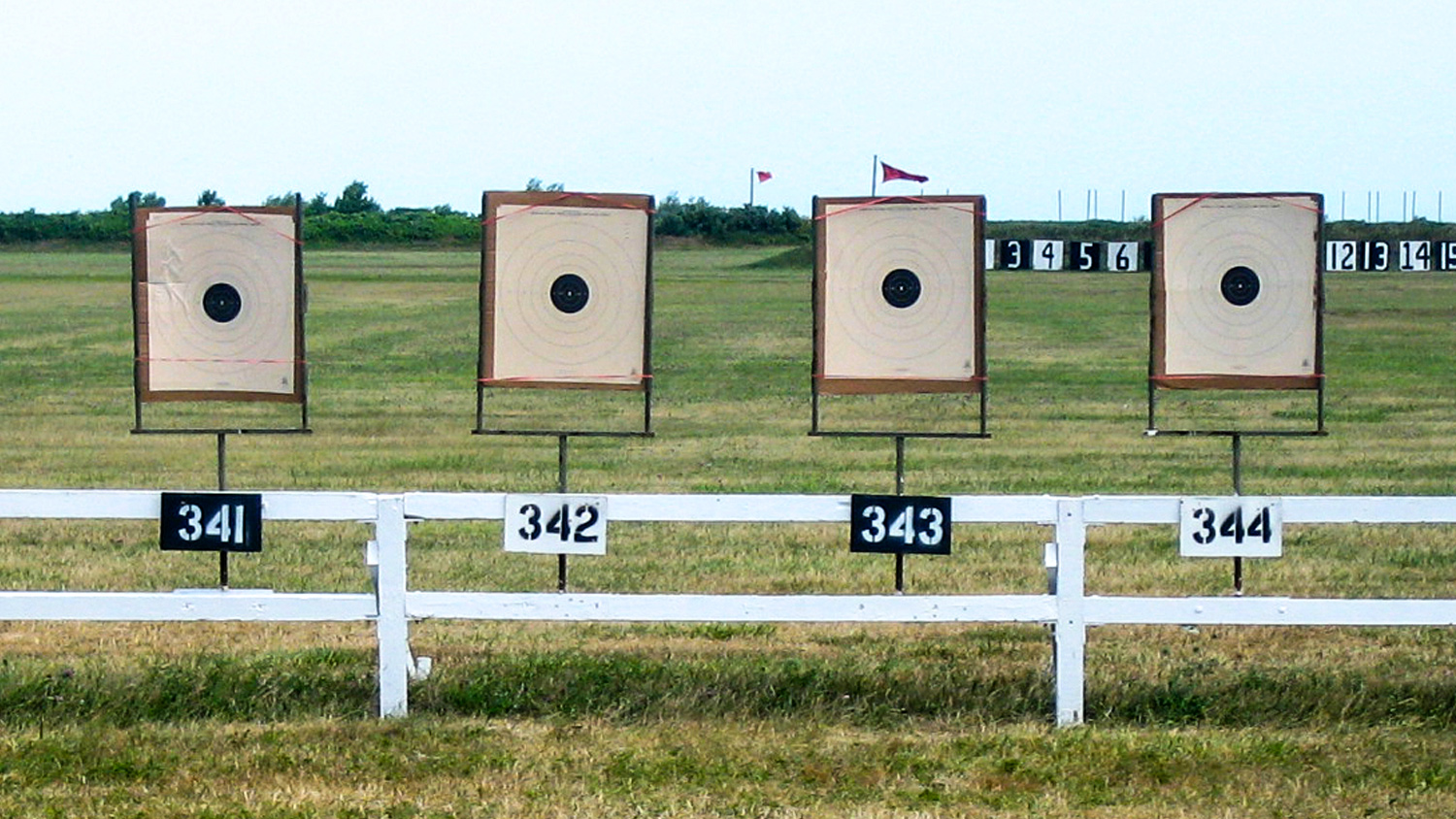
Shooters at the line during Pistol Nationals at Camp Perry, OH.
When contact lens wearers take them off and put on their eyeglasses, they frequently experience eyestrain and difficulty with their depth perception because of this sudden difference in image sizes. Senior-aged shooters who have worn eyeglasses and have undergone successful cataract surgery with an intraocular implant in one eye may have problems adjusting. This eye will now see normal image sizes but the unoperated eye will still see smaller if they are nearsighted, or larger if farsighted. This disparity may cause depth perception difficulties resulting in imbalance until the second eye also undergoes cataract surgery.
Two factors will affect the exact size of images when wearing eyeglasses. First, the higher the prescription, the greater the size differences as compared to images seen by the perfect eye. Second, the farther the lens from the eye, once again, the greater the size differences. To give some examples of how much the image sizes can change, a pair of moderate myopic eyeglasses can make the target appear approximately 10 percent smaller than for those who don’t need eyeglasses. For high myopic corrections, the image size can change closer to 15 percent or more. Conversely, for hyperopic eyeglass prescriptions we would see images larger with similar percentages as the power increases. Research indicates image size change at 1.5 to 1.8 percent per diopter of lens power (see the table below).
Image size comparison relating to lens prescription power.
A +5.00 hyperope would then see the target 18 percent bigger than a -6.00 myope.
Another point of interest is that if our own two eyes vary by at least 1 diopter of power, stereopsis (depth perception) may be affected, perhaps a concern for hunters. There may also be visual discomfort even though the eyeglass prescription is exact and not at fault.
This article will give a sense of comparison with your fellow shooter’s vision but as long as we emphasize trigger control, we can still get off a good shot—regardless of how we see.
More useful articles related to vision by Dr. Norman Wong: